Annabelle Moore

Science Writer.   Communicator.   Editor.   

Word Nerd.   Fact Checker.   Project Whisperer.

Science Writing

How the Bernese Took a Stand for Their Bears

The Bärengraben, or bear pit in Bern, Switzerland, rests beneath a rose garden, at the foot of Nydegg bridge. It abuts the mint green Aare River, which swoops in a horseshoe bend around the city’s medieval Old Town. When I first visited it as a 6-year-old, 24 years ago, it was little more than a drab fortified pit, roughly 108 feet wide and 11.5 feet deep, inhabited by 12 bears. I can still feel the sting of winter and the warm wafting scent of roasted chestnuts emanating from the nearby vendor,

The Sleuths Searching for Montana’s Lost Apples — The Science Writer

“One thing people don’t understand about apples is there is so much diversity [in their] purposes and uses,” says former MHOP program manager and apple enthusiast Katrina Mendrey. “The seasonality of [apples] has been lost in how we eat as a modern society.” Some apples were developed to be scrumptious raw. Others are best used to make sauces, hard ciders, baked goods, vinegar, or to set jams. Through education and outreach, MHOP encourages growers to sustain or plant these resilient trees to st

Survey Shows Americans Confused About Sustainable Seafood

The biggest source of waste in the US seafood supply chain isn’t bycatch or discarded innards—it’s seafood being thrown away at restaurants or home kitchens. A new survey from Johns Hopkins University suggests that when it comes to seafood, Americans are confused about what to buy and when to pitch.

Americans waste as much as 47% of the purchase, according to 2015 research by the Johns Hopkins Center for a Livable Future. This waste is a missed opportunity for human nutrition and is environment

From Combat Boots to Crampons

“Ilma had her boots on before we even rolled out of bed,” says Vallée’s tent-mate the next morning. She laughs at Vallée, documenting their expedition with her GoPro. Bed is generous for the negative-20-degree sleeping bag layered atop an inflatable pad on the side of a mountain. Vallée grins at her camera, face slathered with chalky sunscreen. Waiting to climb, the pair sit with thermoses of coffee sheltered by their yellow-gray nylon tent. This and a snow wall protect them from hurricane-force

Pojoaque Pueblo and archaeologists break new ground by listening, not digging

Amidst the piñon trees and dusty-green sagebrush on high desert mesas north of Santa Fe, New Mexico, Tewa (Tay-wah) elders and youth meet with anthropologists and students for a ‘slow talk’ around the ancestral village of K’uuyemugeh (Koo-yeh-muhn-geh). They’re creating a new working relationship grounded in mutual respect. This shared partnership takes cultural responsibility by using scientific tools, multi-vocal traditional Tewa knowledge and modern technology to recover the lost history of t

Ancient Community Aided Prehistoric Woman with Chronic Illness

Brucellosis, while seldom lethal, leaves its mark on the bones. Based on the damage caused by the disease over the woman’s lifetime, Jones realized the woman likely needed significant support in daily life. In the archaeological record, said Jones, “there are disabilities [where] you can clearly see there was help — there had to be,” because skeletal remains have been found to show advanced stages of disease. This means individuals experiencing debilitating chronic illness must have received som

Institutional Writing & Editing

Science Explainers - Rocky Mountain Research Station - U.S. Forest Service


Guides & Outreach - National Agroforestry Center - U.S. Forest Service

Photo by Susanne Jutzeler, suju-foto on Pexels

Science Communication for Kids

Encircling Ecosystems: here, there, and everywhere! - Natural Inquirer

Investi-gator Science Monograph Fire Toolbox: Reducing wildfire severity with prescribed burning and thinning - Natural Inquirer (publishing forthcoming)


Volunteer Nonprofit Communication

Hi there! Grüezi! Salü!


Annabelle is an endlessly curious  and collaborative freelance science writer, communicator, and editor. She cares deeply about creating accurate and accessible science stories for curious minds of all ages. While living in the world's largest ponderosa pine forest, she earned a B.S. in Biology with minors in Anthropology and Chemistry from Northern Arizona University. She spent a decade teaching, writing, and working in the humanitarian non-profit world before becoming a storyteller. 

She learned to research and report on the crossroads of culture and science in the Johns Hopkins University M.A. in Science Writing program, from which she graduated in 2022.  Her science writing has appeared in Undark, The Science Writer, Abilene Reporter News, and the National Association of Science Writers Student Newsroom. She has contributed storytelling, editing, and communications project management to the American Red Cross, the Texas Master Naturalist Program, the U.S. Forest Service National Agroforestry Center, Rocky Mountain Research Station, and the Natural Inquirer. Her work was recognized in 2023 and 2024 with the Communications Volunteer of the Year Award from the Big Country Chapter of the American Red Cross.  She has received 18 challenge coins for her community service. In 2016, she earned the Bronze, Silver, and Gold level Presidential Volunteer Service Awards for giving over 1,000 hours to her local community.

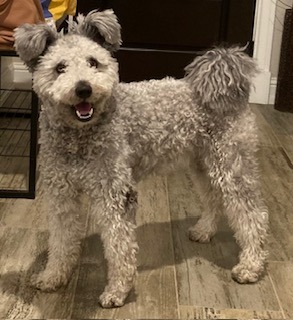
A naturalist who loves unearthing the connections between people, culture, and nature through time (from the microscopic to the biosphere), she lives in the foothills of the Rocky Mountains.  When her nose isn’t in a book, you can find her taking too many pictures of wildflowers, attempting to relearn German and her native Schwiizerdütsch (Swiss-German), and planning adventures with her dog (whom, she is told, looks like a koala or a muppet).

I love learning! I'm nerding out about...
- 2024 Poynter & American Copy Editors Society Intermediate Certificate in Editing
- 2023 Associated Press Stylebook Workshop
- 2023 Poynter & American Copy Editors Society Introductory Certificate in Editing

I once read the Chicago Manual of Style cover to cover—there are two hidden Monty Python references. 

Let's work together! I can help with...

The words                          The big picture                        The fiddly bits                      The ball of yarn           The details
Writing & research         Developmental editing          Line & Copyediting            Editorial Projects         Fact-checking

Photo by Markus Winkler on Pexels

Message successfully sent!

This site is protected by reCAPTCHA and the Google Privacy Policy and Terms of Service apply.